Trek Itinerary Pages
One page per trek: a short answer, trip facts, a day-by-day plan, the cost, permits, departures and the enquiry button.
I’m Ujjwal Rupakheti, a trekking content writer and SEO specialist in Itahari, Nepal. I write trek itinerary pages, trek guides, blog posts and Google Business Profile posts that answer what trekkers search, with permit facts checked at the source. I’ve published 200+ SEO articles, though not yet for a trekking company.
ABC trek itineraryShort name
Annapurna Base Camp trek costFull name
Annapurna Sanctuary trekOlder name
01Definition
A trekking content writer researches and writes the pages a trekking company sells from: itinerary pages, trek guides on permits, seasons, difficulty and packing, blog posts and Google Business Profile posts. The job is to answer what trekkers search before they book, with facts they can rely on once they are on the trail.
Travel content carries a risk most writing doesn’t: a wrong permit fee or a walking day that really takes nine hours reaches a trekker at a checkpost. So the facts are the main deliverable. Every page starts from keyword research for the trek and the market it sells to.
This is my SEO content writing service applied to one industry, with the research method that trekking pages need.
02What I write
Four kinds, each briefed against one search, from the guide a trekker reads first to the itinerary page they book from.
One page per trek: a short answer, trip facts, a day-by-day plan, the cost, permits, departures and the enquiry button.
Permits, best season, difficulty, altitude, packing lists and cost guides. Each answers a question trekkers type into Google, then links to the treks it fits.
Trail updates, comparisons of two treks in one region, and stories from your guides, reaching people months before they choose a company.
Updates, offers and events for your Maps listing, such as a season opening or a new departure. My Google Business Profile guide covers the profile itself.
03Sample structure
The outline I would brief for a typical teahouse trek, as an illustration. It follows how trekkers compare treks: facts first, then the days, then cost and booking.
Annapurna Base Camp Trek: Itinerary, Cost & Permits
Day-by-Day Itinerary3
Cost, permits and what’s included4
The trek name as trekkers type it, plus itinerary or cost, then a 40 to 60 word answer.
Duration, highest point, grade, start and end, best months and accommodation, in one scannable block.
Route, walking hours, altitude and overnight stop, with one first-hand note from your guide each day.
What the price covers and leaves out, and each permit with its issuer and the date it was checked.
The guide’s profile, real reviews, departures, the questions trekkers send on WhatsApp, and the enquiry.
04Sample outline
A guide answers the questions trekkers ask before they pick an itinerary. This illustrative brief for a permits guide names the search each section answers and where its facts come from.
| Section | The search it answers | Where the facts come from |
|---|---|---|
| Opening answer | which permits do I need for Annapurna | The issuing offices below, summed up in 40 to 60 words with the date checked |
| Each permit | ACAP permit fee | The issuer’s own site, such as the NTNC e-permit page for conservation areas |
| Rules on guides | can I trek Annapurna without a guide | Nepal Tourism Board notices and dated national news reports |
| Where to get them | where to get trekking permits in Pokhara | Your agency’s own process, confirmed by the staff who arrange permits |
| Total cost table | Annapurna permit cost total | Issuer fees, each labelled with currency and date |
| Next step | Annapurna trek itinerary | Links to your itinerary pages for treks in the region |
05Research method
Permit pages are where trekking sites disagree most. When I compared top-ranking pages on TIMS card fees in November 2026, they gave different prices for the same card. So every fee and rule on a page I write comes from the office that issues it, with the date I checked it.
The source I check first for each kind of fact. Facts I can’t confirm stay out, or go in marked as varying.
06First-hand details
The details that make a trek page worth reading come from people who walk the trail every season. I collect them from your guides by phone or WhatsApp voice notes, then write them into each day of the itinerary.
07Trust
E-E-A-T stands for experience, expertise, authoritativeness and trust. Google says it isn’t a ranking factor in itself, that trust matters most, and that helpful content shows first-hand experience, such as having visited a place. A trekking company has that experience; it just has to be on the page.
Each page shows who wrote it and which guide checked the route, with their real names and years on the trail.
Photos from your own departures, with descriptive file names and alt text, not the stock images every agency uses.
A “last checked” date on every fee and rule, with a link to the issuing office, so trekkers can confirm it themselves.
Real walking hours, with the hard days stated plainly, so trekkers arrive with the right expectations.
08AI answers
Google says AI Overviews and AI Mode have no extra requirements beyond being indexed and eligible for a snippet, and its May 2026 guide asks for unique, experienced content. ChatGPT search leaves out sites that block OpenAI’s OAI-SearchBot crawler.
Each common question, such as how hard a trek is, gets a clear answer first, with the trek named in full.
“A beautiful trek for all levels” is on every agency’s site. Your guide’s note on which day is hardest after rain is not.
Google says llms.txt files and special AI markup aren’t needed for Search. Any structured data still has to match the visible page.
More on how answer engines choose sources is in my guide to how to do SEO in 2026.
09Seasonal updates
Trekking demand follows the seasons. The Nepal Tourism Board recorded 128,443 international arrivals in October 2025 alone, out of 1,158,459 for the whole year. The pages trekkers find when they start planning are the ones updated before each season begins.
Permit fees and rules checked, prices and departures updated before searches rise.
Your guides’ spring notes added, and any monsoon treks brought up to date.
The biggest update: fees, rules, prices and departures for October and November, plus trail changes after the rains.
Search Console shows which pages gained or lost, and the weak ones are rewritten.
10From you
You know the trails; I know how trekkers search. Most of what I ask for already exists in your office or on your guides’ phones.
Send these once; after that, each new page only needs a guide interview.
11Proof
I’ve published 200+ SEO articles across five domains. I have not written for a trekking company yet, so this page sets out how I would do the work. You can start with a single page before deciding on more.
200+
SEO articles published
5
domains written for
3+
years in SEO and the web
Content writer, 2024–2025. Tech articles and gadget reviews, with specifications and prices in rupees.
SEO content strategy and QA, 2025–2026. Full Stack Web Developer there since June 2026.
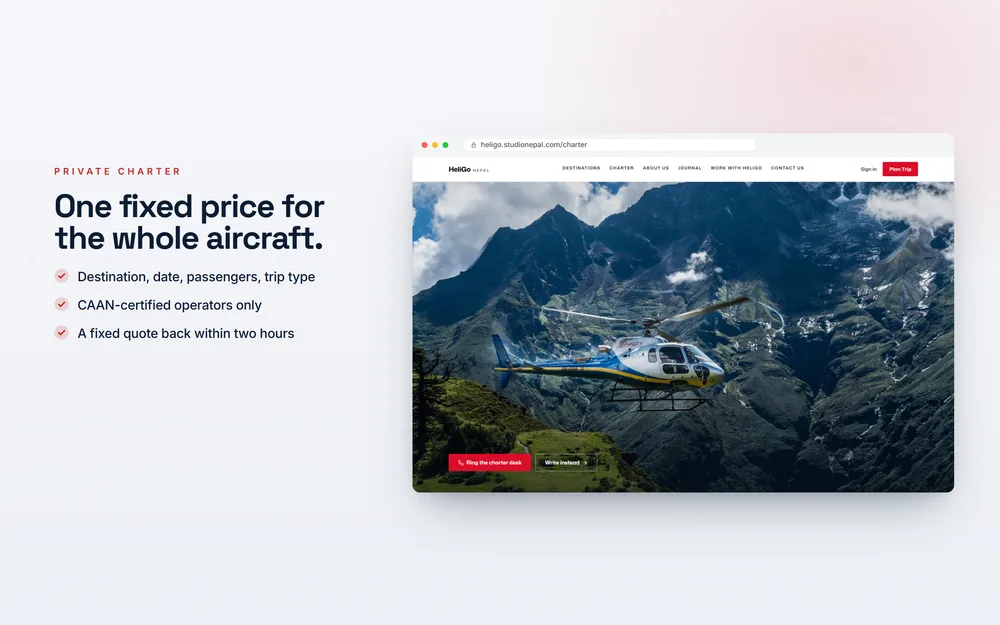
Tourism platform I built. A helicopter charter marketplace with its own indexable page for each destination, from Lukla to Muktinath.
Travel platform I built. Trekking packages, tours and hotel stays from verified agencies. See the HamroYatra case study.
Pricing
I quote trekking content per page, or as a monthly plan, at a fixed price agreed before writing starts. The quote depends on how many treks you sell and how much research each one needs.
| Content | Price | Timing |
|---|---|---|
| Trek itinerary pageFacts box, day-by-day plan, cost, permits and FAQ | Fixed quote per page | Agreed in the brief |
| Trek guidePermits, best season, difficulty or packing list | Fixed quote per page | Agreed in the brief |
| Monthly contentBlog posts and Google Business Profile posts | Monthly quote | Planned around the seasons |
| Seasonal refreshFees, rules, prices and dates on existing pages | Fixed quote per page | Before spring and autumn |
If your current site makes itinerary pages hard to publish, a trekking company website with a CMS is from NPR 35,000, and online trip booking with deposits from NPR 60,000. For rankings beyond content, see SEO for trekking companies. Every starting price is on my services page. Clients abroad are quoted in USD with a written contract.
Cost, experience, permit facts, page length, languages and updates.
Ask me on WhatsAppI quote trekking content per page or as a monthly plan, at a fixed price agreed before I start. The price depends on the number of treks and the research each one needs. Clients abroad are quoted in USD with a written contract. Building or rebuilding the website itself is priced separately.
Not yet. I have published 200+ SEO articles across five domains, and I built HeliGo Nepal, a helicopter charter marketplace with a search page for each destination. Trekking content would be a new niche for me, so this page sets out the method, the sources and what I need from you first.
I take each fee and rule from the office that issues it, such as the Nepal Tourism Board for TIMS or NTNC for conservation area permits, and print the date I checked it. Your staff confirm how it works in practice. If two sources disagree and I can’t settle it, the page says so.
Long enough to answer what a trekker needs before booking, and no longer. Most itinerary pages need a trip facts box, a day-by-day plan, the cost and inclusions, permits, departures and a short FAQ. I read the pages that already rank for the trek, then plan sections that cover what they leave out.
I write in English and Nepali. For markets such as Germany or France, I can brief a native translator and set up each language on its own URL with hreflang, so Google shows the right version. Each language needs its own keyword research, because trekkers in each country search in their own words.
Yes. I write short updates, offers and event posts for your Maps listing, such as a season opening or a new departure, each with a photo and a link to the right trek page. Google archives posts after six months unless you set a date range, so a monthly plan keeps the profile active.
Google doesn’t ban AI-assisted writing, but it treats pages mass-produced mainly to manipulate rankings as spam, and its guide to AI search asks for unique, first-hand content. Trek pages that repeat what every agency already says rarely stand out. Your guides’ experience is what makes a page different, and no tool can invent it.
At least once before each main season, and whenever a fee, rule or route changes. Before spring and autumn I check permit fees and rules, update prices and departure dates, and add new notes from your guides. A dated “last checked” line shows trekkers the page is current.
Send your website and the treks you sell. I reply within one working day with questions or a first estimate.
Ujjwal RupakhetiReplies within one working day
What do you need written?
Opens WhatsApp with your message started.