Trekking website SEO means building one strong page per trek, with a day-by-day itinerary, the full cost and dated permit facts, then earning reviews, links and a Google Business Profile that prove the company is real. Done well, it brings trekkers who book direct instead of through an online travel agency, with no commission to pay.
I am Ujjwal Rupakheti, a web developer and SEO specialist in Itahari. I built HeliGo Nepal, a charter marketplace with a search page for each destination, and have published 200+ SEO articles. I have not run SEO for a trekking company yet, so this is the method I would use, checked against Google’s own documentation.
To hand the work over instead, see my SEO services for trekking companies. Every starting price is on my services page.
How Does Trekking Website SEO Work?
A trekker searches in stages, and each stage needs a different page. First they research which trek, which season and how hard. Then they compare itineraries and cost. Last, they choose a company by name, reviews and Google Maps. Most agency sites only serve that last stage.
| Stage | Example search | The page that fits |
|---|---|---|
| Research | best time for Annapurna Base Camp trek | A trek guide or season guide |
| Compare | Manaslu circuit trek itinerary | An itinerary page for that trek |
| Budget | Everest Base Camp trek cost | A cost section, or a cost and permits page |
| Choose | trekking agency in Thamel | Your home page and Google Business Profile |
| Check | [your company name] reviews | Your reviews on Google and Tripadvisor |
How to Do Keyword Research for Each Trek and Market
Start from your trek list, not from a tool. For each trek, collect every name trekkers use and the words they add to it. Then repeat it for each country you sell to, because a trekker in London, Munich or Delhi describes the same trip differently.
- List each trek’s names: official, short and older, such as ABC, Annapurna Base Camp and Annapurna Sanctuary.
- Add the modifiers trekkers type: itinerary, cost, permits, difficulty, best time, packing list and a number of days.
- Read the live Google results for each. If guides rank, the search needs a guide; if itineraries rank, it needs an itinerary page.
- Set Google Keyword Planner and Google Trends to each target country, to compare demand and see when searches rise.
- Map every search to one page, so two of your pages never compete for the same trek and intent.
Choose markets from data. Nepal Tourism Board figures, reported on 2 January 2026, put international arrivals in 2025 at 1,158,459, with India (292,438) and the United States (112,316) the largest source countries. Your own enquiries matter more. My keyword research page shows a finished keyword map.
Anatomy of a Trek Itinerary Page That Ranks: The Checklist
An itinerary page is where trekkers compare you with every other agency selling the same trek. The winners answer every question on one page, in the order trekkers ask. Use this checklist for each trek.
| Part | What to include | Why it matters |
|---|---|---|
| 1. Title and H1 | The trek name as people search it, plus itinerary, days or cost | Matches the search and earns the click |
| 2. Opening answer | 40 to 60 words: what the trek is, how long, how hard, the starting price | The passage snippets and AI answers quote |
| 3. Trip facts box | Days, highest point, grade, start and end, season, accommodation | Lets a trekker compare in seconds |
| 4. Day-by-day plan | Route, walking hours, altitude, overnight stop and a guide’s note per day | Shows first-hand knowledge |
| 5. Map and altitude profile | A route map and an elevation chart, with alt text | Shows how hard it is at a glance |
| 6. Cost and inclusions | Price per person, what is included and excluded | Removes the main reason to leave |
| 7. Permits | Each permit, its issuing office and the date the fee was checked | The facts trekkers verify before paying |
| 8. Dates and booking | Fixed departures or private dates, deposit and cancellation terms | Turns reading into an enquiry |
| 9. Guide and author | Who wrote the page and which guide checked the route | Makes experience and trust visible |
| 10. Real reviews | Reviews of this trek from Google or Tripadvisor, linked to the source | Proof from people who went |
| 11. FAQ | The questions trekkers send on WhatsApp, answered briefly | Catches the long, specific searches |
| 12. Internal links | Related treks, the region guide, the permits page and the cost page | Helps Google and readers find the next page |
If two treks share most of a route, write each page’s own facts and days rather than copying text, or near-identical pages will compete with each other.
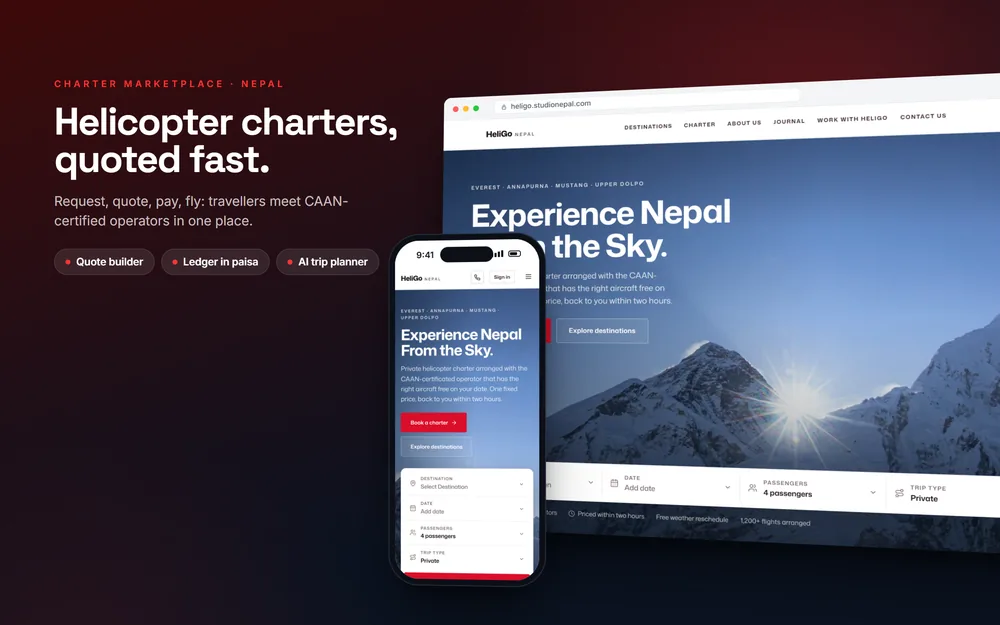
Case study: HeliGo NepalA charter marketplace I built, where each destination from Lukla to Muktinath has its own indexable page and private areas are blocked from crawling.
How to Write Trek Cost and Permit Pages
Cost and permit searches come from people close to booking, and they are where trekking sites are least reliable. When I compared top-ranking pages on TIMS card fees in November 2026, they disagreed on the price of the same card. A page that shows its source stands out.
For every fee, name the issuing office, link to it and print the date you checked it. For example, the National Trust for Nature Conservation’s e-permit site states an entry fee of NRs. 3,000 for foreigners and NRs. 1,000 for SAARC nationals, tax included, with no permit needed for children under 10 (checked 3 November 2026).
- Cost page: the trek price, then every extra the trekker pays: permits, flights or jeeps, meals outside the package, tips and insurance.
- Permit page: one table per region with each permit, issuer, fee and date checked, linked from every itinerary in that region.
Permit rules change without warningOn 1 April 2023 the Nepal Tourism Board revised the TIMS rules so that foreign trekkers needed a guide and a TIMS card in 14 trekking areas, as The Himalayan Times reported. Pages promising independent trekking there went out of date. Review every permit table before each season.
How to Build Multi-Language Trek Pages with Hreflang
If you sell to German, French or Spanish-speaking trekkers, a translated page can rank in their language, and hreflang tells Google which version to show each reader. Translate the main content, not just the menu: Google treats pages whose main content stays untranslated as duplicates.
- Each language version must list itself and every other version; if the links aren’t reciprocal, Google ignores them.
- Use full URLs with https, never relative paths.
- Use an ISO 639-1 language code with an optional ISO 3166-1 region, such as
deoren-GB. A region code alone is not allowed. - Add
x-defaultfor readers whose language you don’t cover. - Pick one method: HTML link tags, HTTP headers or the XML sitemap.
<link rel="alternate" hreflang="en" href="https://www.example.com/annapurna-base-camp-trek/" />
<link rel="alternate" hreflang="de" href="https://www.example.com/de/annapurna-base-camp-trek/" />
<link rel="alternate" hreflang="x-default" href="https://www.example.com/annapurna-base-camp-trek/" />
Research keywords again in each language with a native speaker, because a word-for-word translation rarely matches what people type. My technical SEO checklist for 2026 covers hreflang with the other checks I run before a launch.
Speed and Image SEO for Trekking Websites
Trekking sites are heavy with photos, and that is usually what makes them slow. Google’s Core Web Vitals targets are a Largest Contentful Paint within 2.5 seconds, Interaction to Next Paint under 200 milliseconds and Cumulative Layout Shift under 0.1. Test on a phone, over mobile data.
- Serve photos as WebP or AVIF, both supported by Google Images, at the size they display.
- Use
srcsetfor different screens, with asrcfallback, as Google recommends. - Give every image a width and height, so the page doesn’t jump while loading.
- Name files descriptively, such as
abc-trek-sunrise.webp, notIMG_2041.jpg. - Write alt text that describes the photo, and place it next to the day it shows.
- Lazy-load photos below the first screen, but never the main image.
Which Structured Data Can a Trekking Website Use?
Structured data helps Google understand a page, but it never guarantees a rich result and must truly represent what is visible. For a trekking company a few types are useful, and some popular ones are not eligible.
| Markup | Use it? | What to know |
|---|---|---|
| Organization | Yes | Name, logo and contact details, on the home page |
| LocalBusiness, such as TravelAgency | Yes | One per real office, matching your Business Profile |
| Article or BlogPosting | Yes | For trek guides and blog posts, with author and dates |
| BreadcrumbList | Yes | Since January 2025, breadcrumbs only show in desktop results |
| Image metadata and VideoObject | Yes | For your own trek photos and videos |
| Review stars for your own company | No | Google doesn’t show stars when the business controls the reviews about itself |
| Event for trek departures | No | Google’s rules say not to mark trip packages as events |
| FAQPage | Optional | FAQ rich results stopped showing on 7 May 2026; the questions still help readers |
<script type="application/ld+json">
{
  "@context": "https://schema.org",
  "@type": "TravelAgency",
  "name": "Example Treks",
  "url": "https://www.example.com/",
  "telephone": "+977-1-0000000",
  "address": {
    "@type": "PostalAddress",
    "streetAddress": "Example Marg, Thamel",
    "addressLocality": "Kathmandu",
    "addressCountry": "NP"
  }
}
</script>
Want This Done for Your Trekking Site?Technical SEO audits start from NPR 15,000 and monthly SEO from NPR 30,000.
Ask for a quoteHow to Get More Reviews on Tripadvisor and Google
Reviews decide the last step. Google says more reviews and positive ratings can help local ranking, and both Google and Tripadvisor set firm rules on how you ask.
- Ask every trekker the same way. Google bans discouraging negative reviews or asking only happy customers, and Tripadvisor encourages businesses to ask all customers.
- Never offer anything for a review. Google prohibits payment, discounts or free services for reviews, and Tripadvisor penalises businesses that offer incentives.
- Don’t script it. Google also lists asking for reviews with specific content, so don’t ask trekkers to mention keywords or a guide’s name.
- Ask on the last evening of the trek, with short links to your Google and Tripadvisor pages, and reply to every review with specifics.
- Show reviews on your site, linked to the source, but don’t mark them up for stars; self-serving review stars are not eligible.
Google Business Profile for Trekking Agencies in Thamel or Lakeside
Most trekking agencies sit in Thamel in Kathmandu or Lakeside in Pokhara, so many profiles compete in a small area. Google ranks local results on relevance, distance and prominence, and says there is no way to pay for a better local ranking. What you control is an accurate, complete and active profile.
- Use your real business name. Google doesn’t allow added keywords or locations, so “Best Trekking Agency Thamel” breaks the rules.
- List a real office staffed during business hours; virtual offices are not eligible.
- Keep one profile per location. A second office in Lakeside can have its own; a second listing for the same office cannot.
- Choose as few categories as possible, and add your main treks as services with your own photos.
- Post season openings and departures. Posts older than six months are archived unless you set a date range.
My Google Business Profile setup guide covers verification step by step. I also work with businesses in Kathmandu and Pokhara.
How to Earn Links to a Trekking Website Without Buying Them
Links still tell Google which sites others trust, but buying them is a gamble. Google’s spam policies list buying or selling links for ranking purposes as link spam, and a paid link must be marked rel="sponsored" or rel="nofollow".
- Seasonal trail updates, written with your guides, that bloggers and forums cite when conditions change.
- Guide profiles and interviews that journalists and travel writers can quote.
- Real partners, such as lodges, gear shops and photographers, linking where the relationship is genuine.
- Listings you qualify for, such as an industry association’s member directory.
- Original photos offered free to bloggers, with a credit link.
How to Reduce OTA Dependence and Win Direct Bookings
Online travel agencies bring trekkers you might never reach yourself, but every booking carries the commission in your contract, and the traveller’s details stay with the platform. SEO won’t replace OTAs overnight. It shifts the balance, so trekkers who first see you on an OTA can also find and book you directly.
Reach, at a Price
Commission on every booking, the platform’s cancellation rules and little contact with the trekker.
Your Terms, No Commission
A direct line to the trekker. It needs a site that ranks, answers questions and takes a deposit.
- Use the same company name on your site, Google profile, Tripadvisor and OTA listings, so a search for your name finds your site.
- Give trekkers a reason to book direct, such as private dates, and check your OTA contract before offering lower direct prices.
- Take deposits online. A trekking company website with online booking and deposits starts from NPR 60,000.
- Look at Google’s Things to do, which lets tour and activity providers list free in Search, usually through an approved connectivity partner.
- Track enquiries and bookings by source in Google Analytics 4.
HamroYatra, a travel platform I built, lists trekking packages from verified agencies.
How to Appear in AI Overviews and ChatGPT Answers
Google says there are no extra requirements to appear in AI Overviews or AI Mode: the page must be indexed and eligible to show a snippet. Its May 2026 guide to generative AI search adds that you don’t need llms.txt files, special markup or content split into chunks. It asks for unique, experienced content beyond common knowledge.
A line calling a trek “beautiful and suitable for all levels” is on every agency’s site. A note from your guide on which day is hardest after rain is not.
- Allow OAI-SearchBot in robots.txt: OpenAI says sites that opt out are not shown in ChatGPT search answers. GPTBot, its training crawler, is a separate setting.
- Answer each common question first under a clear heading, naming the trek in full.
- Keep facts consistent across your site, Google profile and OTA listings.
- Measure it in Search Console, which counts AI Overviews and AI Mode traffic in the Performance report under Web.
My guide to how to do SEO in 2026 covers answer engines in more depth.
A 90-Day Trekking Website SEO Plan
Ninety days is enough to fix the foundations and rebuild the pages that sell, but not to judge results; most sites need three to six months before rankings move clearly. This is the order I would work in.
Fix and Measure
Set up Search Console, Bing Webmaster Tools and Google Analytics 4 goals for WhatsApp and enquiry clicks. Fix crawl, speed and mobile problems, clean up the Google Business Profile and build the keyword map.
Rebuild the Treks That Sell
Rewrite the five treks that bring the most enquiries to the checklist above, with guide notes for each day. Add the cost pages and a permit page for each region, with dated facts.
Earn Trust and Expand
Start the review routine, publish the first season guide and a trail update, begin partner outreach, and add a translated trek page if a market justifies it.
After day 90, check Search Console for treks that gained impressions and pages that get clicks but no enquiries. My trekking company SEO service runs this plan as monthly SEO. If you only need the writing, my trekking content writer page explains how I research trek pages.

About the author
Ujjwal Rupakheti
I am a full-stack web developer and SEO specialist based in Itahari, Koshi Province, Nepal. I have worked in web development and SEO since 2022 and have published more than 200 SEO-optimised articles across five-plus domains. Since June 2026 I have been a full-stack web developer at Ektukra Digital Agency, after a year there on SEO content strategy and QA testing.