An AI chatbot for business in Nepal answers customer questions on your website or WhatsApp from your own FAQs, prices and policies, using a method called retrieval-augmented generation. It suits FAQs, bookings, order status and lead capture, with a person taking over when it is unsure. Model costs are small; the build, upkeep and WhatsApp messages usually cost more.
I am Ujjwal Rupakheti, a full-stack developer in Itahari. I build AI features on Gemini and other model APIs, and I have built them into products: a trip planner that hands travellers to a person, a resume scorer with a fallback for when the model fails, and an MCP server that keeps AI inside staff permissions. This guide is what I explain before quoting a chatbot.
Prices and rules below come from Meta, Google, OpenAI and the Nepal Law Commission, checked on 3 November 2026. They change often, so check the linked pages again before you budget.
What Can an AI Chatbot Do for a Business in Nepal?
A chatbot is good at answering the same questions all day in the same careful way, and at collecting details before a person steps in. It is poor at anything it cannot look up: live stock, a booking calendar or an order’s status, unless it is connected to the system that holds them.
| Use case | What it does well | Its limits |
|---|---|---|
| FAQs | Prices, opening hours, delivery areas, fees, documents needed | Only as current as your documents; a stale price list gives stale answers |
| Bookings | Asks the date, people and service, then offers real free slots | Needs your booking system’s API; it must never confirm a slot it has not checked |
| Order status | Looks up an order by number and phone and explains where it is | Needs your order system and a check that the person asking owns the order |
| Lead capture | Asks qualifying questions and passes a clean summary to sales | Needs consent before it stores a name, phone number or email |
| Staff help | Answers questions about internal policies and records | Must follow each person’s permissions, or it leaks data |
Connecting a bot to your bookings, orders or stock is the same work as any other API integration: a documented endpoint, a permission check and a log of every call.
How Does a Chatbot Answer from Your Own Data?
It looks things up before it answers. This method is called retrieval-augmented generation, or RAG. You do not train a new AI model on your data. You keep your documents in a searchable store, find the passages that match each question, and give only those passages to the model with an instruction to answer from them.
- Collect the sources: FAQs, price lists, policies, product details and past answers your staff are happy with.
- Split them: break each document into short passages, each about one topic.
- Index them: turn each passage into an embedding, a list of numbers that captures its meaning. Google’s Gemini docs describe embeddings for semantic search and for building RAG systems.
- Retrieve: when a question arrives, find the passages whose meaning is closest to it.
- Answer: send the question and those passages to the model, with an instruction to use nothing else.
- Hand over: if no passage matches, the bot says it is not sure and offers a person.
You answer customers of Example Shop, Itahari.
Use only the passages below. If they do not answer
the question, say you are not sure and offer a person.
Reply in the language the customer used.

[1] Delivery: Itahari and Dharan next day.
    Other districts 3 to 5 days.
[2] Returns: within 7 days, with the bill.

Customer: dharan ma delivery kati din lagcha?
Updating the bot then means updating a document, not retraining anything. My university project HamroYatra uses this pattern: before its trip planner answers, it searches the platform’s active listings and passes the closest matches to Gemini 2.5 Flash, so it suggests trips that can actually be booked. Google also offers a managed File Search tool in the Gemini API for teams that would rather not run their own index.
Can an AI Chatbot Understand Nepali?
Often, but test it before you trust it. Google lists Nepali among the languages of the Gemini web app. The Gemini API documentation describes its newer embedding model as working across more than 100 languages, but it does not name Nepali or publish an accuracy figure. I have not found a published accuracy figure for business chatbots in Nepali, so treat any vendor’s percentage with care.
The bigger challenge is how people type. Customers in Nepal write in English, in Romanised Nepali and in Devanagari, often mixed in one message, and one Nepali word can have several Roman spellings. My Domain Finder Agent romanises Devanagari words, turning सपना into sapna; going the other way, from loose Roman spelling back to meaning, is where bots slip.
- Write key answers, such as prices and policies, in both English and Nepali.
- Tell the model to reply in the language and script the customer used.
- Keep prices, dates and phone numbers in digits, and check every one in testing.
- Test real customer messages in all three ways of writing, not translated examples.
Website Widget or WhatsApp: Which Channel Should You Use?
Start where your customers already ask. A website widget is cheaper to run and fully under your control. WhatsApp suits customers who already message you there, but it adds Meta’s rules and per-message charges. A sensible order is the website first, then WhatsApp once real questions show what the bot needs.
| Website widget | WhatsApp Business Platform | |
|---|---|---|
| What you need | A script on your site and a small server | A Meta business portfolio, a business phone number and the Cloud API or a Solution Provider |
| Messaging fees | None; you pay the AI model and hosting | Per delivered message, by category and country |
| When you can reply | Any time the visitor is on the page | Free-form replies within 24 hours of the customer’s last message; templates after that |
| Rules | Your own, plus the law | Meta’s terms and messaging policies |
| Best for | Pre-sales questions and lead capture | Order updates, bookings and repeat customers |
The free WhatsApp Business app on your phone has quick replies, but a chatbot needs the WhatsApp Business Platform. Read Meta’s terms first: the version last modified on 23 September 2026 bars providers of general-purpose AI assistants when the AI is the primary, rather than incidental or ancillary, function on offer. A bot that answers questions about your own shop is a different use, but confirm it with Meta or your Solution Provider.
Want a Chatbot That Knows Your Business?Send me your website, the questions customers ask most and where they ask them. I’ll reply with what I would build first and a quote for that use case.
Ask about a chatbotHow Much Does WhatsApp Business Platform Messaging Cost?
Meta charges per delivered message. Since 1 July 2025, the rate depends on the message category and the recipient’s country calling code, and Meta does not charge for messages customers send to you. From 1 October 2026, Meta also charges for service replies beyond 1,000 free ones per business phone number each month.
| Message type | What it is | How it is charged |
|---|---|---|
| Customer to business | Anything a customer sends you | Not charged |
| Service | Free-form replies inside the 24-hour window, such as a chatbot’s answers | 1,000 free per number each month, no rollover; charged after that from 1 October 2026 |
| Utility | Templates about an existing order or booking | Per message, including replies inside the window from 1 October 2026 |
| Marketing | Offers, announcements and reminders to buy | Per message |
| Authentication | One-time passcodes | Per message |
Since 1 October 2026, Nepal (+977) has its own rates on Meta’s rate card instead of the “Rest of Asia Pacific” rate. Meta publishes the rates as downloadable files, so I have not copied numbers here; check the current file before you budget.
For a support bot, the free 1,000 service replies may cover a small business. A busy shop answering thousands of questions a month, or sending order updates as templates, should model the cost from the rate card first.
How Much Do AI Model APIs Cost per Message?
Model APIs charge per token, a small piece of text. You pay for the tokens you send, which include your instructions, the retrieved passages and the chat history, and for the tokens the model writes back, which cost more. Embeddings for your documents are charged separately and are cheap.
| Model | Input | Output |
|---|---|---|
| Gemini 2.5 Flash-Lite | 0.10 | 0.40 |
| Gemini 2.5 Flash | 0.30 | 2.50 |
| OpenAI gpt-5-nano | 0.05 | 0.40 |
| OpenAI gpt-5-mini | 0.25 | 2.00 |
| Embeddings: gemini-embedding-001 / text-embedding-3-small | 0.15 / 0.02 | None |
An illustration, not a quote.Say a shop handles 1,000 chats a month, each sending about 4,000 tokens and receiving 300. That is 4 million input and 0.3 million output tokens. On Gemini 2.5 Flash at the prices above, the model costs about USD 1.95 a month; on gpt-5-mini, about USD 1.60. The build, upkeep and WhatsApp messages usually cost more than the model.
Two cost rules I follow. Set a message limit per user, as HamroYatra does with 20 planner messages a day and 5 a minute. And use a paid API tier for customer data: Google’s pricing page marks free-tier content as used to improve its products, and paid-tier content as not used.
Is an AI Chatbot Legal Under Nepal’s Privacy Act?
Yes, if it collects and uses personal information the way the law requires. Nepal’s Privacy Act, 2075 (2018), in Nepali वैयक्तिक गोपनीयता सम्बन्धी ऐन, २०७५, was authenticated on 18 September 2018. Its definition of personal information includes a person’s address, telephone number, email and identity card numbers, which a chatbot can easily collect.
- Section 12(2): consent must be obtained when collecting a person’s personal data.
- Section 12(3): data a body corporate collects with consent may be used only for the purpose it was collected for.
- Section 26(1): personal information held by a body corporate must not be used or given to anyone without consent, except in listed cases such as a court order.
- Section 29: acting against listed provisions, including Section 26(1) and Section 12(4) on sharing details such as health, income or business dealings without consent, can mean up to three years in prison, a fine of up to NPR 30,000, or both.
- Say clearly that the customer is talking to an AI, and how to reach a person.
- Ask before storing a name, phone or email, and say what it is for.
- Never ask for citizenship, passport or card numbers in chat.
- Use API tiers that do not train on your data. OpenAI says API data is not used for training unless you opt in, and keeps abuse-monitoring logs for up to 30 days.
- Keep transcripts only as long as you need them, and mask phone numbers in staff views.
This is a developer’s summary of the Act’s text, not legal advice. For anything sensitive, such as health or financial data, ask a lawyer.
How Do Human Handover and Guardrails Work?
A good business chatbot knows when to stop. It answers what its sources cover, hands everything else to a person with the conversation attached, and never takes an action it cannot check. These limits matter more than the choice of model.
In HeliGo Nepal, the AI planning assistant suggests helicopter routes from a traveller’s days, budget and group, then passes the conversation to a person when the traveller is ready. It runs as its own service, so bookings keep working if the AI is slow or down. In RecruitFlow, Gemini scores resumes on a fixed rubric, and a rule-based engine takes over if the model call fails.
- Hand over on words like refund, complaint or manager, and whenever no source matches.
- Check prices, slots and order details in your system, never from the model’s memory.
- Give the bot only the data the customer may see. Eutaa’s MCP server lets AI read company data only through the same permission checks as a person.
- Keep a person in charge of decisions. In CivicSathy, Gemini suggests a complaint’s severity only when an administrator asks, and the suggestion is stored for review.
- Never take payments or share another customer’s details in chat.
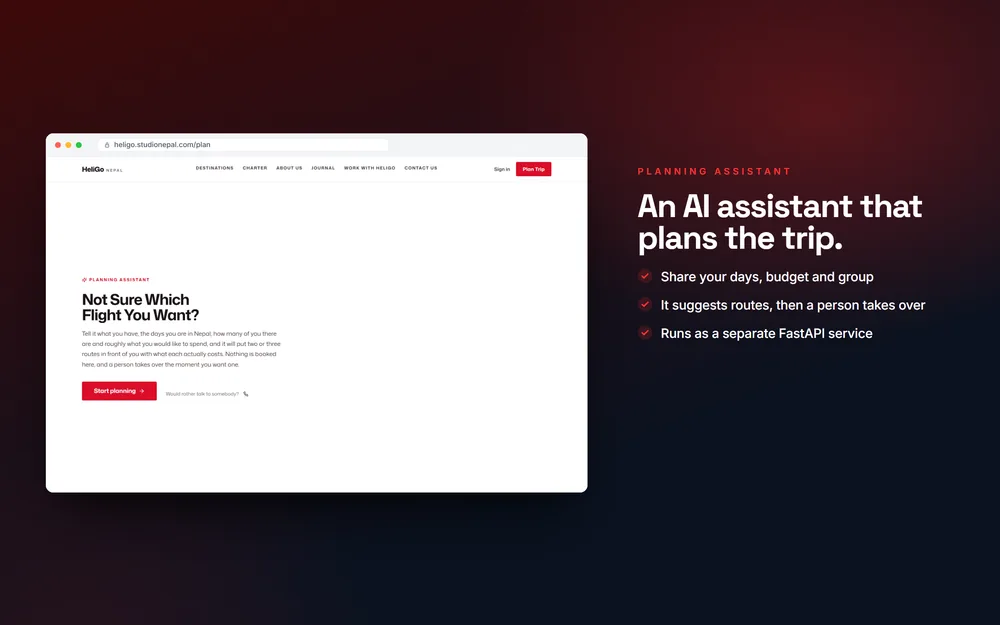
Case study: HeliGo NepalA helicopter charter marketplace with an AI planning assistant that suggests routes, then hands the conversation to a person. It runs as a separate FastAPI service.
How Do You Test an AI Chatbot Before Launch?
Test it like software, with a fixed set of real questions and the answers you expect. Run the same set again after every change to your documents or instructions, so a fix in one place does not break an answer somewhere else.
- Collect real questions: 50 to 100 from your WhatsApp, Messenger and phone notes, with names and numbers removed.
- Write the right answers: including the questions where the right answer is a handover.
- Test three ways of writing: English, Romanised Nepali and Devanagari, plus mixed messages.
- Try to break it: ask for discounts it cannot give, another customer’s order, or for it to ignore its instructions.
- Launch quietly: on the website first, with staff reading every transcript for the first weeks.
The same discipline is behind my QA testing work: the checks that would cost money if they failed are written down and run every time.
How Much Does an AI Chatbot Cost for a Business in Nepal?
It depends on what the bot must do, which is why I quote chatbots per use case after a short call. A bot that answers FAQs on one website is a small job. A bot on WhatsApp that books slots, looks up orders and hands over to staff in three ways of writing Nepali is a larger one.
| Factor | Lower cost | Higher cost |
|---|---|---|
| Channels | Website widget only | Website and WhatsApp |
| Data | One FAQ and price list | A catalogue synced from your system |
| Actions | Answers only | Bookings and order lookups through your API |
| Language | English only | English, Nepali and Romanised Nepali |
| Handover | An email to staff | A shared inbox where staff take over live |
- Running costs, paid by you: the AI model, WhatsApp messages, hosting and any inbox tool.
- Off-the-shelf tools: monthly subscriptions, usually priced in dollars, that suit simple FAQ bots.
When a chatbot is part of a larger system, it is quoted with it, as part of my custom software development in Nepal. Every other starting price is on my services and pricing page. I work from Itahari with businesses across Nepal, including Kathmandu.
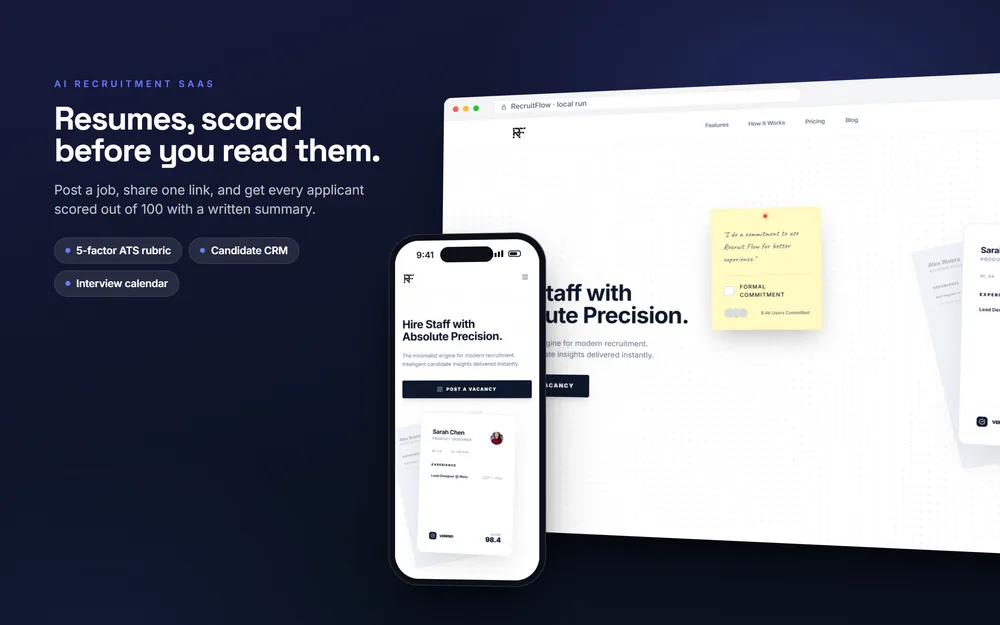
Case study: RecruitFlowAn AI recruitment SaaS with a chat assistant for questions about the candidate pool, Gemini scoring on a fixed rubric, a fallback when the model fails and rate limits on AI chat.

About the author
Ujjwal Rupakheti
I am a full-stack web developer and SEO specialist based in Itahari, Koshi Province, Nepal. I have worked in web development and SEO since 2022 and have published more than 200 SEO-optimised articles across five-plus domains. Since June 2026 I have been a full-stack web developer at Ektukra Digital Agency, after a year there on SEO content strategy and QA testing.