For Clients
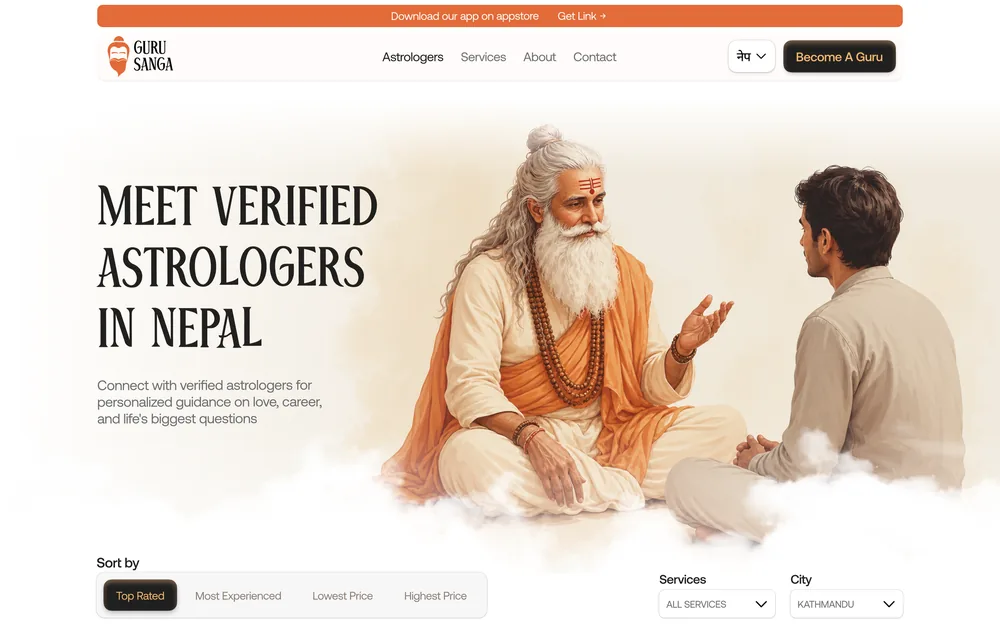
- Search by service, city and way of meeting; sort by rating, price or experience
- Profiles in five tabs, from services to reviews
- Pay, join an online session and see receipts
- Cancel up to 12 hours ahead
09Case study · Guru booking platform
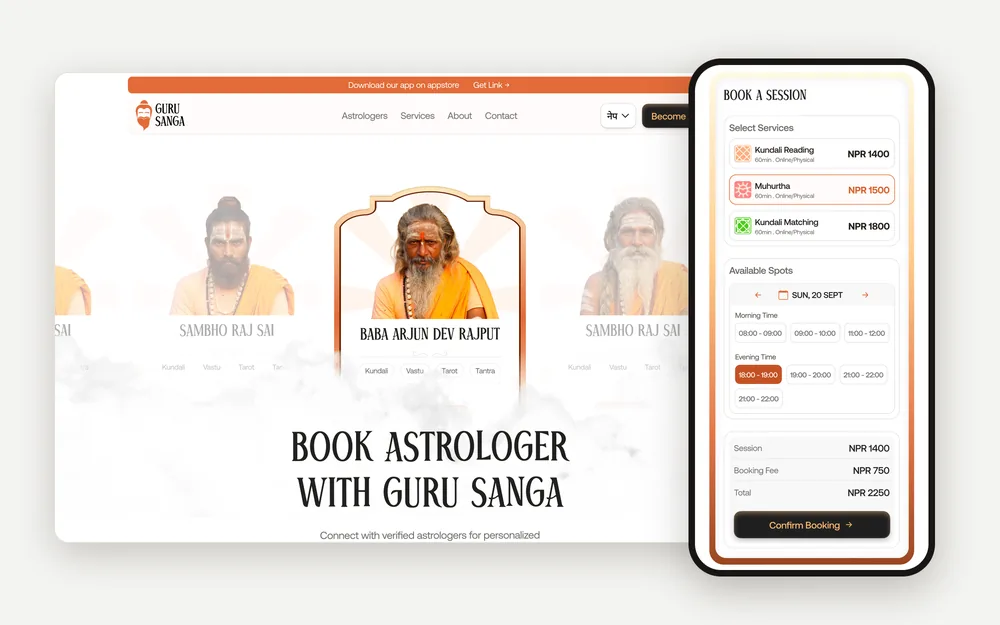
GuruSanga is an online guru booking platform for Nepal. People find a verified astrologer, pandit, vastu consultant or counsellor, pick a real slot from that guru’s own diary, and pay by scanning a QR code. I built it for a client in August and September 2026, from a Figma design.
01The problem
People in Nepal look for an astrologer, a pandit or a vastu consultant at real turning points: a marriage proposal, a new house, a job change, naming a child. Finding one still happens by word of mouth and phone calls. You cannot see prices, free times or credentials before you ring, and the category has enough scams to make people wary.
Gurus have the opposite problem: bookings arrive as phone calls, and asking for payment is awkward when your work is advice.
GuruSanga puts verified gurus, their real prices and their free time on one page.
02The solution
GuruSanga has four parts: a public site with a searchable listing, a full profile for each guru and the booking screen, then a client area, a portal for gurus and a console for the platform’s staff.
Every guru, price and opening hour is read from the database, and the layout works on screens from 320 pixels wide. It is the kind of custom software I build for businesses that run on bookings.
03Features
A clear price and a real time for the client, a calm diary for the guru, and proper tools for the staff in between.
04Booking flow
A booking starts as a request. The platform stands between the two sides, so nobody chases anybody for money.
Filter by service, city and way of meeting, then compare prices, experience and languages.
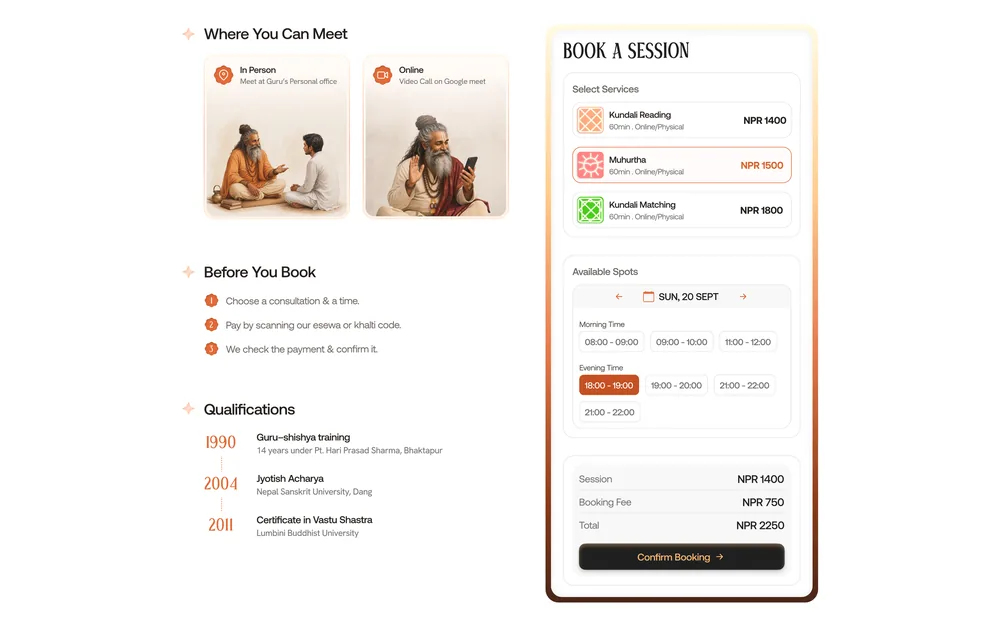
Choose online, office or home visit. Times come from the guru’s own diary.
Scan the eSewa or Khalti code, pay, then enter the transaction code.
Staff check the payment. Only then is the guru told and the address shared.
At the office with a map, at home, or on Google Meet.
Each booking gets a short reference, such as GS-1001, that is easy to read out on the phone.
05Architecture
The browser only talks to the Next.js site, which passes API calls through, so the sign-in cookie stays first-party as browsers block third-party cookies.
Staff, gurus and clients each have their own table, sign-in page and session cookie, and every guru or client query is limited to the person signed in.
The dashboards share a design system I first built for HeliGo Nepal.
06Design
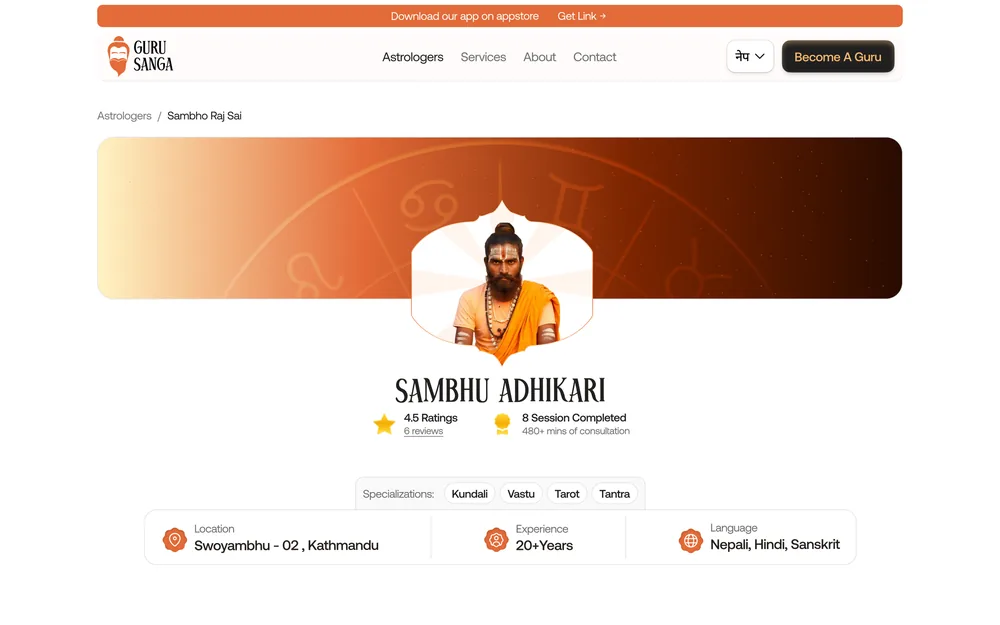
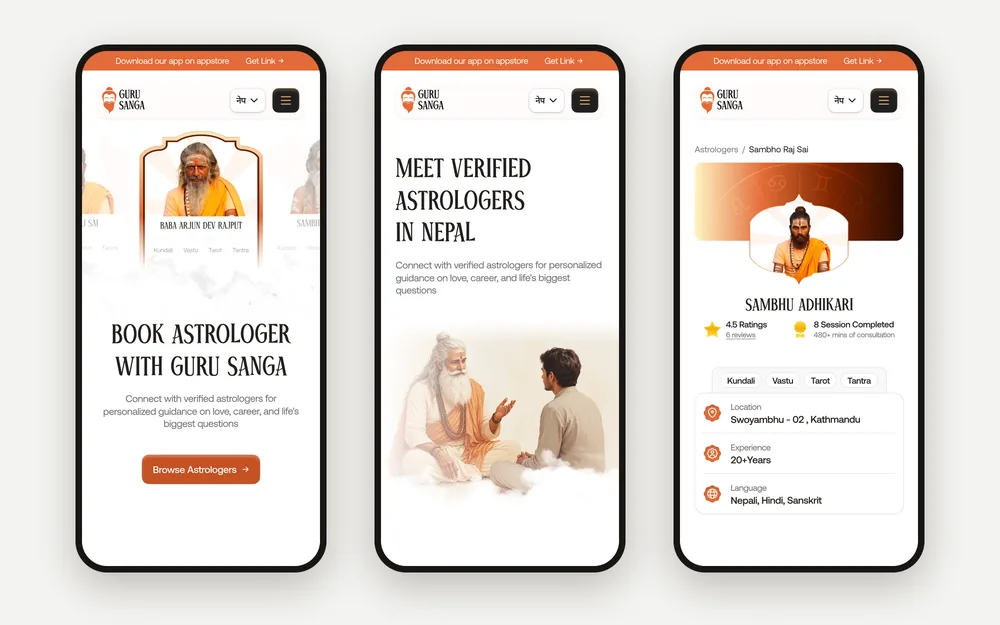
GuruSanga was designed in Figma before any code was written: the homepage, the astrologer listing and the guru profile, each at desktop width and at 390 pixels for phones. Saffron and deep brown carry the brand, guru portraits sit in an arched frame, and a display face sets the headings.
The profile answers what a careful client asks first: where the guru sits, how long they have practised and which languages they speak, and the price shows before Confirm Booking. I check the same things in a UI/UX audit.
07Engineering
The four decisions that shaped GuruSanga, and the problem each one solves.
01
A markup is added for the client and a commission comes out of the guru’s price. Both rates are stored on every booking, so a rate change never rewrites old books, and the figures always add up. Money is where database design matters most.
02
This market pays by scanning a QR code, so the platform shows its code and asks for the transaction code afterwards. That records a claim, not money. Only staff confirming it writes a ledger line, so nobody can confirm a booking by typing a number.
03
Nepal Time is a fixed UTC+5:45, so slot maths is plain arithmetic that never depends on the server’s time zone. Weekly hours and exceptions become windows, cut into 30-minute starts for each service’s length. Taken slots are removed, not greyed out.
04
A Google Meet room is created only when staff approve a paid booking. Join opens five minutes before the start, and five minutes after the booked end the event is deleted, so the link dies. It never appears in a list, so a screenshot cannot leak a room.
Profiles and the listing are how a platform like this finds clients, so I built them for search engines and AI assistants from day one, as I approach SEO in Nepal.
08Screens
Most clients will arrive on a mid-range Android phone over mobile data, so the phone layouts were designed alongside the desktop ones.
09Status
GuruSanga is in development for a client, and the complete loop already works.

In development for a client
A client books and pays, staff confirm it, the guru starts the session, and the guru’s share lands on a statement and then in a weekly payout.
Related services
Looking for a service booking platform developer in Nepal? These are the services behind GuruSanga, and every starting price is on my services page.
For more booking work, see HeliGo Nepal, Sajilai and Nimtto, or every project side by side in my web development portfolio. The person behind them is on my about page.
What GuruSanga does, how booking and payment work, and what a platform like it costs to build.
Ask me on WhatsAppGuruSanga, also written Guru Sanga, is an online guru booking platform for Nepal. Clients find a verified astrologer, pandit, vastu consultant or counsellor, book a fixed-price consultation in a real slot, and pay by QR. I built it for a client from a Figma design.
You choose a guru, a service and a way to meet, then pick a slot from the guru’s own diary. You pay by scanning a QR code and enter the transaction code. Staff check the payment and confirm, and only then is the guru told.
On GuruSanga, yes. Puja and rituals is one of the 12 services, and each service lists where it can happen: online, at the guru’s office or at your home. For a home visit, any travel fee is added to the booking.
There is no card gateway, on purpose. The client scans the platform’s eSewa or Khalti QR, pays from their own phone and sends back the transaction code, which staff confirm. Gurus are paid weekly from a running statement once they pass a threshold.
A guru uploads a citizenship certificate or passport, plus one licence or certificate for the work they offer. Staff accept or reject each document. The booking API refuses any guru who is not both verified and listed, so an unchecked profile cannot take money.
Each approved online booking becomes a Google Calendar event with a Meet room, sent to both people with reminders. The guru presses Start and the client presses Join, from five minutes before the start. Five minutes after the booked end, the link stops working.
A simple website for one astrologer or pandit starts from NPR 18,000. A booking platform with listings, slots and payments is a SaaS project, from NPR 70,000 for a first version in 6–12 weeks. A full marketplace is quoted per module.
Yes. I build booking platforms with listings, availability, payments, client areas and staff consoles, as in GuruSanga and HeliGo Nepal. Scope, timeline and price are fixed in writing before work starts. See how I work as a web developer in Nepal.
Send a short note about your project and budget. I reply within one working day with questions or a first estimate.
Ujjwal RupakhetiReplies within one working day
What are you planning?
Opens WhatsApp with your message started.