Prishta: School Report Card and CAS Software for Nepal
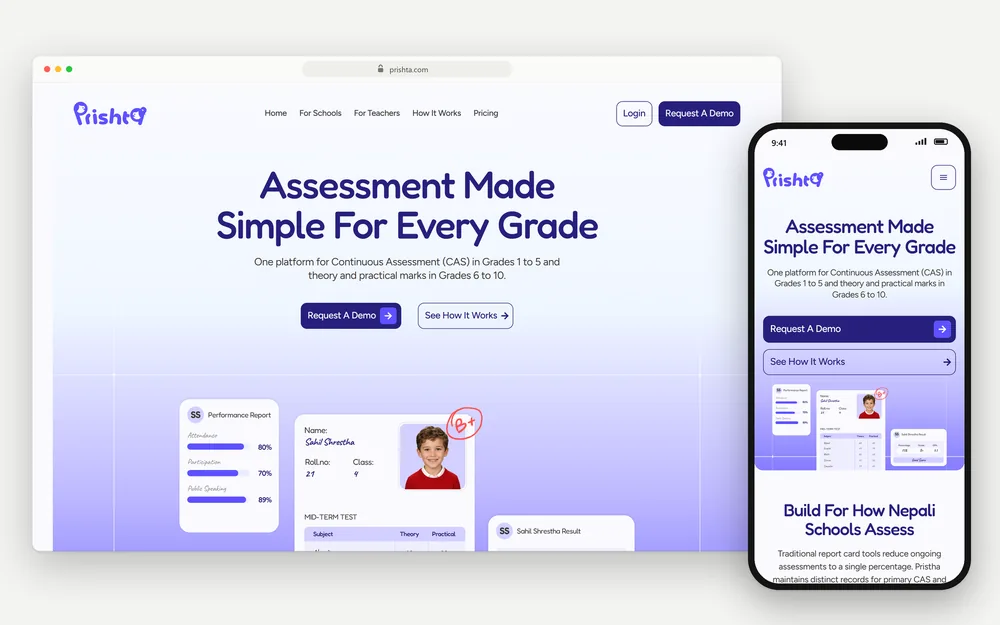
Prishta is continuous assessment (CAS) and report card software for schools in Nepal, from grade 1 to grade 10. I worked on it at Ektukra Digital Agency in September and October 2026, reviewing, fixing and testing the code and deploying it to prishta.com. It is a multi-tenant SaaS: teachers enter marks on a phone, the office reviews and locks them, and families read the finished report card online.
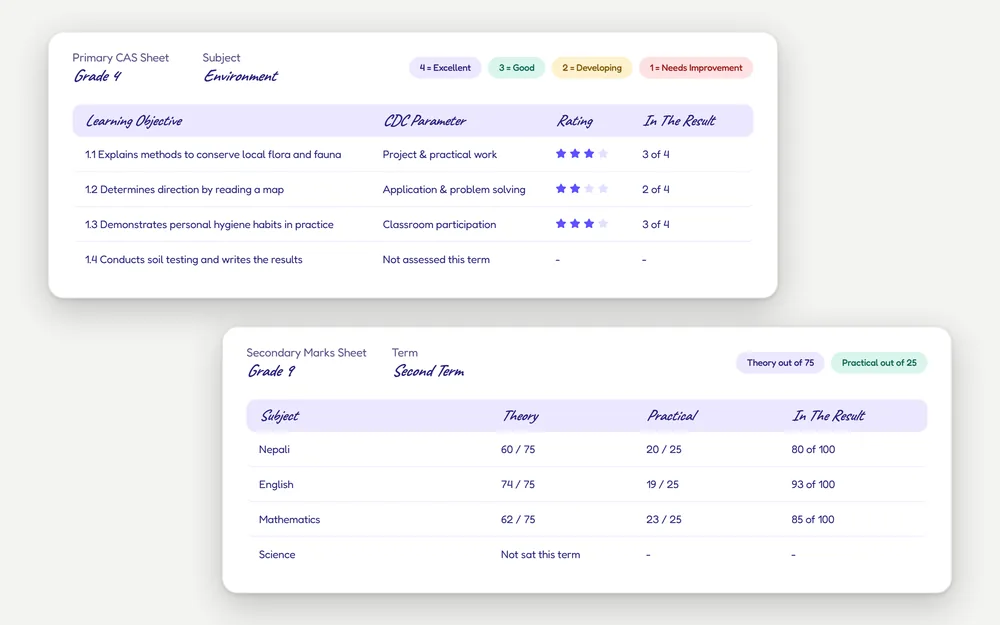
Grades 1–5 rated on the CDC 4-3-2-1 CAS scale
Grades 6–10 theory and practical marks on NEB grade bands
Report cards in Nepali and English, with Bikram Sambat dates
Schools in Nepal run continuous assessment on spreadsheets: nine subjects, up to twenty learning objectives each, seventy students and an eight-band grading scale, held together by formulas that break whenever a child joins mid-term.
An empty cell quietly becomes a zero and drags a child’s average down. Report cards are formatted by hand in Word. And once a card has gone home, nothing stops a mark changing in the file behind it, or records who changed it.
Prishta replaces that workbook with one record that teachers fill, the office signs off and families can trust.
02The solution
What Prishta Does: One Platform for Principals, Teachers and Parents
Prishta is one API and one PostgreSQL database behind three front ends serving five audiences: a public site where a school asks for a demo, an operator console that creates and bills each school, and one school portal where a principal, a teacher and a parent each sign in.
The portal decides what to show from the account itself, not a menu choice, so a teacher never lands on a principal’s screens. It is the kind of SaaS product I like working on most: a real workflow, modelled carefully.
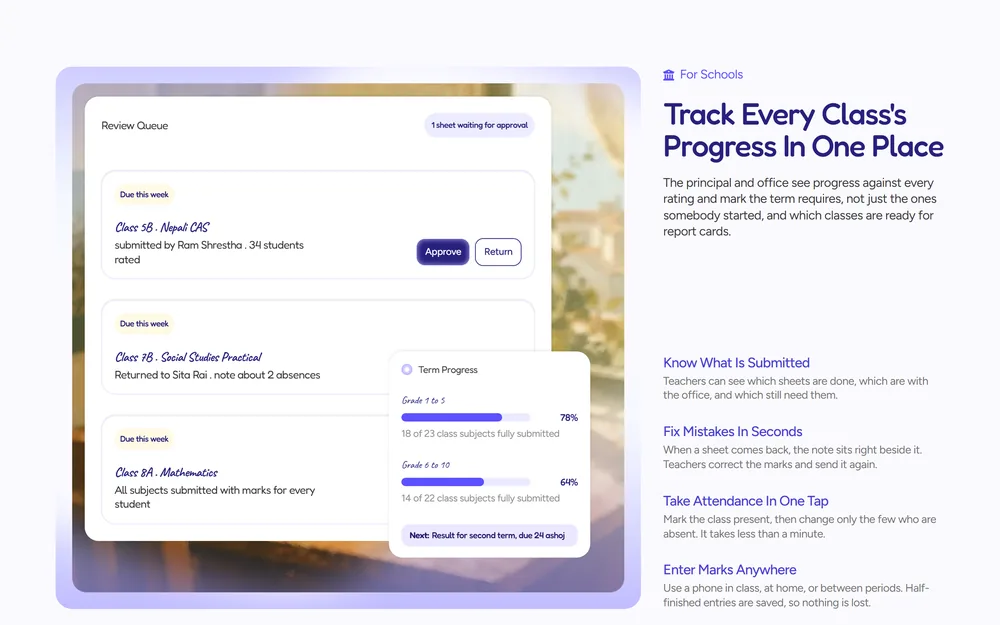
The office review queue and term progress, as shown on prishta.com.
03Assessment modes
Two Assessment Modes: CAS for Grades 1–5, Marks for Grades 6–10
The grade decides the mode, not the school. A Grade 2 child is rated on learning objectives, and a Grade 9 student gets theory and practical marks.
Years, terms, classes and subjects, with students imported from one file
An Academic Ledger with nine views, including at-risk lists
Report cards in ten layouts with the school’s logo and signature
ID cards with QR codes, certificates and a one-step year-end close-out
For Teachers
Mark sheets only for their assigned subjects and sections
Drafts are saved, so a phone works between periods
A remark per student, printed on the card
Register, homework, unit tests and lesson plans
For Parents
Sign in with a school-issued access code, no email needed
One account for siblings at the same school
Report cards, attendance, remarks and notices
English or Nepali, switched from the top bar
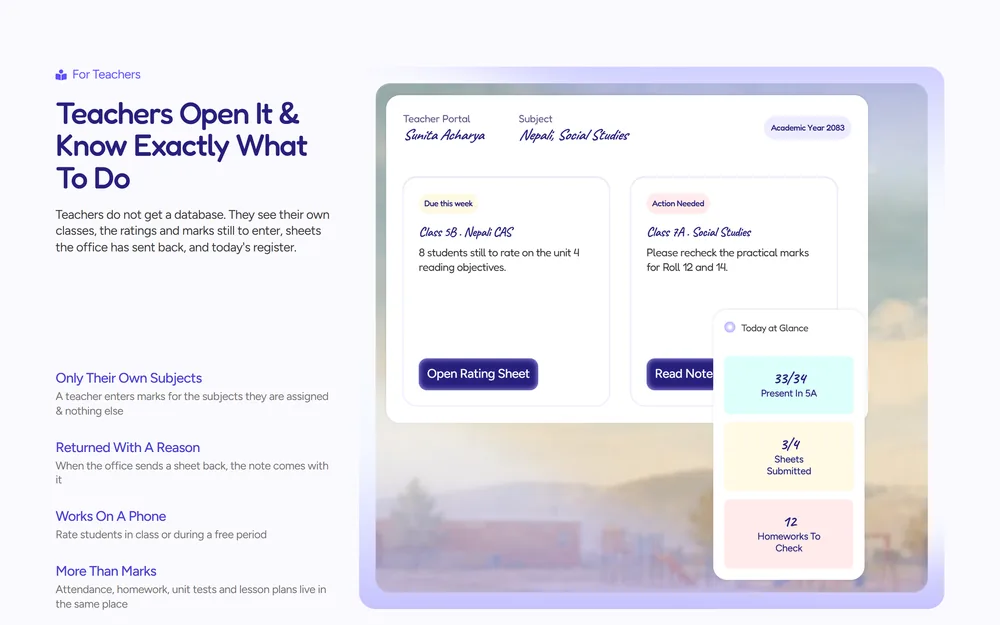
The teacher portal as shown on prishta.com: what is due, what came back and today’s register.
06Architecture
Prishta Architecture and Tech Stack
A TypeScript monorepo: one Fastify API, one PostgreSQL database and three React front ends, shipped as Docker containers. Every school is a tenant, and the design protects that boundary first.
Front endsReact 18 + Vite 6Public site, operator console and school portal
DeployDocker on Coolifynginx by hostname, Cloudflare in front
The Prishta Tech Stack
Every record carries its school, and every request is checked against the school in the caller’s token. A refusal is a 404, not a 403, so nobody can probe another school.
Dates are stored Gregorian and shown in Bikram Sambat first, from an almanac table for BS 2070 to 2098, because Nepali month lengths are published, not calculated.
The browser prints report cards because it shapes Devanagari correctly, and ledger exports keep Nepali names readable in Excel.
Vitest 41,061 API tests in 57 suitesReal PostgreSQL, no mocks
Ops
DockerCoolifynginxCloudflareNightly backups at 02:00 Nepal time
Languages
EnglishNepali in DevanagariBikram Sambat and AD dates
07Engineering
Engineering Decisions Behind Prishta
Six decisions that shaped Prishta, each from how a Nepali school actually works.
01
A Missing Mark is Never a Zero
An unassessed objective or a subject not sat is left out of averages, ranks and pass counts, and named in a warning. In a spreadsheet it becomes a zero that can turn a good student into an NG.
02
Results That Cannot Drift
The master ledger freezes each section’s term and stores the whole class ledger, so a card reprints years later exactly as signed. Reopening needs a written reason, and is refused while its cards are with parents.
03
Nepal’s Today, Not the Server’s
Nepal is UTC+05:45, so for almost six hours a day the UTC date is still yesterday, which once kept the morning register shut until 05:45. Every date check now uses Nepal’s calendar.
04
A Calendar Checked Against the Real One
The first Bikram Sambat table drifted a day by BS 2075 and two from 2081, silently. It was rebuilt with tests against the published New Year dates, so a bad row now fails the build.
05
Parents Sign in with an Access Code
Many guardians have no email on file, and siblings share one phone, so neither can be a login. Parents use a code the school hands over, and see only the children linked to them.
06
A Ledger Fast Enough for a Whole School
The budget is 500 students in under two seconds. Each view loads in four indexed queries and does the maths in memory, and the suite measures under 300 ms. That is careful database design at work.
Security Built Around the Tenant Boundary
Prishta holds children’s marks, so access is narrow by default, as in the APIs and QA testing I do for clients.
Every request checked against the caller’s own school
Teachers reach only their assigned subjects and sections
Staff permissions can only narrow access
A deactivated account stops on its next request
Sign-in locks for 15 minutes after 10 failed attempts
Every submission, approval, lock and unlock is audited
08Pricing
Prishta Pricing for Schools in Nepal
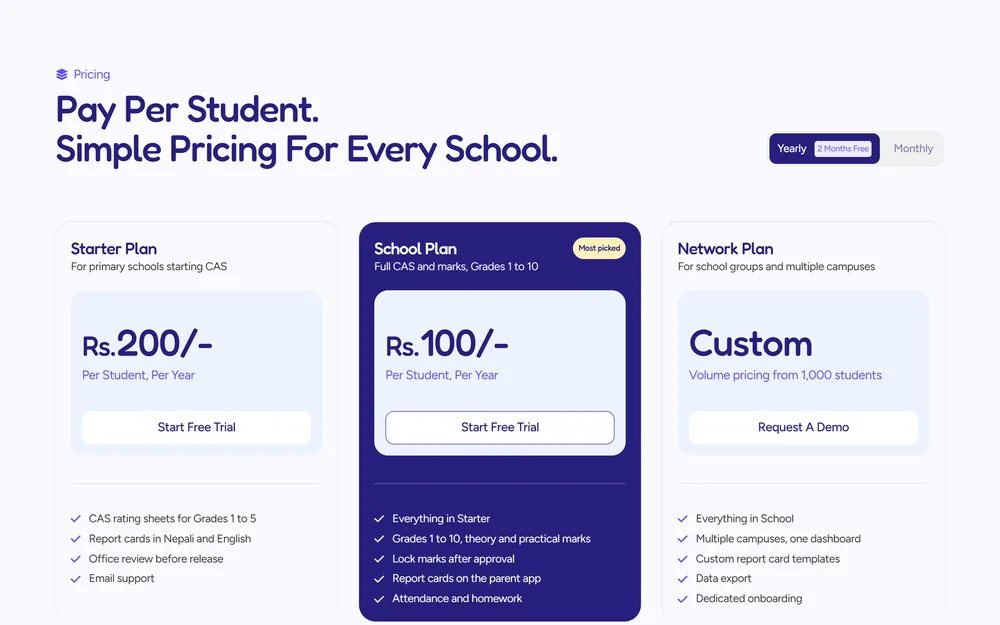
Prishta is priced per student and billed yearly. The site lists a Starter plan at Rs 200 per student per year for primary CAS, a School plan at Rs 100 for grades 1 to 10 with locked marks and the parent portal, and a custom Network plan from 1,000 students.
Any plan can be tried free for 30 days with one class, with no payment details needed.
Per-student plans and the free trial, as listed on prishta.com.
09Status
Where Prishta Stands Today
Prishta is live at prishta.com, brought to schools by Ektukra Digital Agency, where I work as a full-stack web developer.
Live, with a 30-day free trial
It is the most complete product I have worked on: five audiences, two assessment schemes, a ledger that cannot drift and 1,061 tests against a real database.
Prishta is continuous assessment and report card software for Nepali schools, grades 1 to 10, live at prishta.com. Teachers rate objectives or enter marks, the office reviews and locks them, and families read bilingual report cards online. I worked on it at Ektukra Digital Agency, from code review, fixes and tests to the Docker deployment that serves prishta.com.
What is CAS in Nepal?
CAS is the Continuous Assessment System used in Nepali schools. Teachers assess learning objectives through the term instead of judging a child on one exam. For grades 1 to 5, the CDC framework uses nine CAS parameters and a 4-3-2-1 rating scale.
Does Prishta Follow the CDC Framework?
Yes. Grades 1 to 5 come set up with the nine CDC CAS parameters and the 4-3-2-1 rating scale, with up to 20 learning objectives a subject, each tagged to one parameter. A school can rename parameters, and marks already awarded are never rewritten.
How Does Prishta Mark Grades 6 to 10?
Grades 6 to 10 use theory and practical marks, graded on the NEB letter bands from A+ to NG under the Letter Grading Directive 2078, with NG below 35%. Each subject has its own pass mark, and a subject not sat is left out of the average.
Can a Teacher Change Marks After Report Cards Go Out?
Not alone. Pushing a report card locks the marks behind it. Changing one needs the office to unlock it with a written reason, which pulls the card back from parents until it is pushed again. Every lock, unlock and change is in the audit log.
Does Prishta Support Nepali and Bikram Sambat Dates?
Yes. Names, objectives, remarks and subjects can be typed in Devanagari, and report cards print them correctly. Dates show in Bikram Sambat first, then AD. The parent portal switches between English and Nepali, and ledger exports keep Nepali names readable in Excel.
Can Parents See Report Cards Online?
Yes. When the school pushes report cards, each family is notified and reads the card on the parent portal, with attendance, remarks and notices. Parents sign in with a school-issued access code, see only their own children and never see the class rank.
How Much Does Prishta Cost?
Prishta is priced per student and billed yearly. The site lists a Starter plan at Rs 200 and a School plan at Rs 100 per student per year, plus a custom Network plan from 1,000 students. Any plan can be tried free for 30 days with one class.
Can You Build School Management Software for My School?
Yes. I build SaaS products and custom management software like Prishta for clients in Nepal and abroad. A first SaaS version starts from NPR 70,000 and usually takes 6 to 12 weeks, and custom systems are quoted per module. See SaaS development for details.
Planning Software Like Prishta? I’ll Send a Fixed Quote.
Send a short note about your school or product and your budget. I reply within one working day with questions or a first estimate.